
البحث, اضطرابات العمود الفقري
11-09-2026
تاريخ النشر : 21-07-2026
تحديث في : 21-07-2026
الموضوع: اضطرابات العمود الفقري
الوقت المقدر للقراءة : 1 دقيقة
Severe spinal deformities are among the most challenging conditions in spine surgery, requiring exceptional surgical expertise as well as careful, long-term planning. This was the diagnosis of a young patient from Poland who came to IRCCS Ospedale Galeazzi-Sant'Ambrogio, where she was given a new chance at a fuller, more independent life.
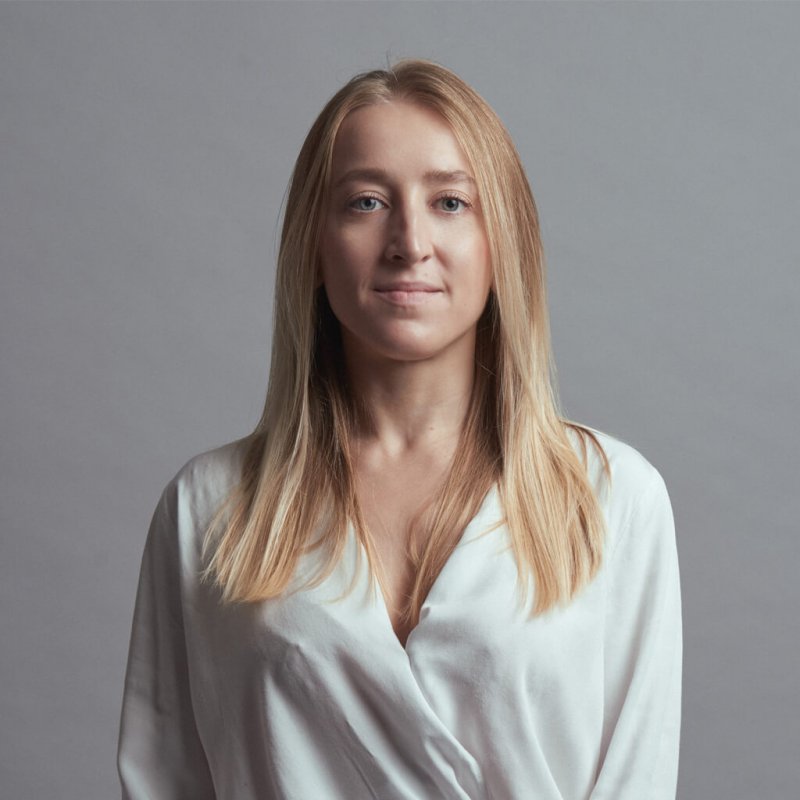
A severe spinal deformity, a neck almost completely "hidden" within the chest, a spinal cord bent to an extreme degree, and the real risk of progressive paralysis over time. This was the highly complex clinical condition of Małgorzata, a young Polish patient with neurofibromatosis, a genetic disorder that can cause severe spinal deformities among its many manifestations, when she arrived at IRCCS Ospedale Galeazzi-Sant'Ambrogio.
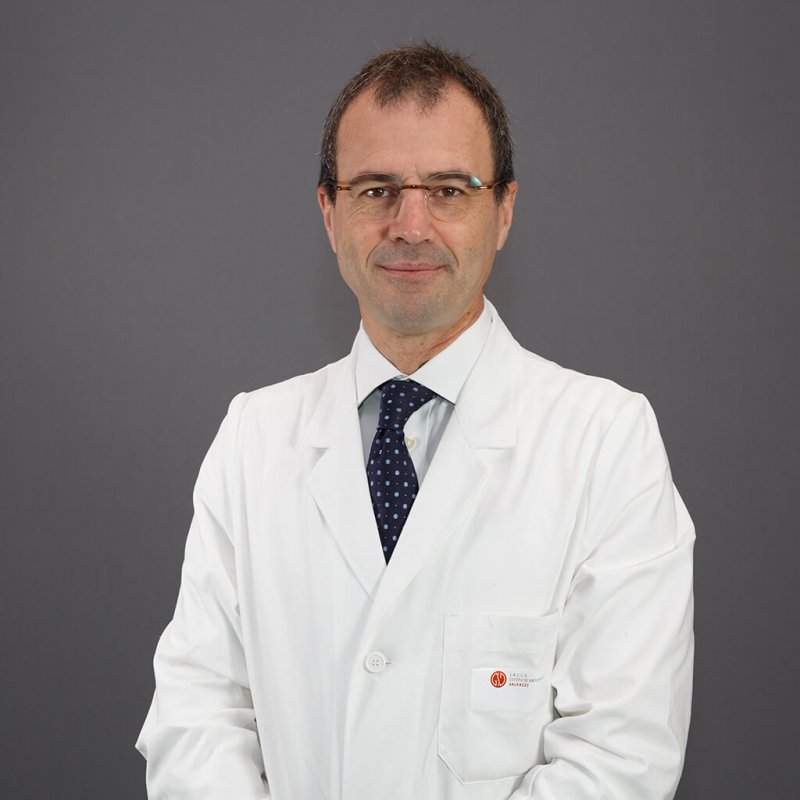
After undergoing previous surgeries abroad and facing complications during her clinical journey, Małgorzata was referred to Dr. Pedro Luis Berjano, Head of the GSpine4 Spine Surgery Unit at IRCCS Ospedale Galeazzi-Sant'Ambrogio, for an exceptionally complex procedure aimed at correcting the deformity, protecting her spinal cord, and restoring the possibility of a more normal life.
Małgorzata's decision to seek treatment at IRCCS Ospedale Galeazzi-Sant'Ambrogio was also driven by the trust built through recommendations from other international patients. From the very beginning, the International Department of Gruppo San Donato supported both the patient and her family by coordinating the entire process, assisting with the collection and sharing of medical records required for treatment in Italy, and facilitating communication with the Polish healthcare system. This behind-the-scenes coordination played a crucial role in maintaining continuous dialogue between the family, the Italian clinical team, and healthcare professionals in Poland, making access to highly specialized care abroad clearer and more manageable.
"This was a case at the very limits of what surgery could achieve. The decision to operate required balancing two equally important factors: the significant risks of such a complex procedure against the patient's future quality of life if no treatment was performed. The deformity was not only extremely difficult to accept from a physical and psychological perspective, but it also exposed the spinal cord to progressive damage," explains Dr. Berjano.
Neurofibromatosis is a genetic disorder that can lead to the development of neurofibromas and, in some patients, significant skeletal abnormalities. When the disease affects the spine, it may result in severe deformities that are particularly difficult to treat.
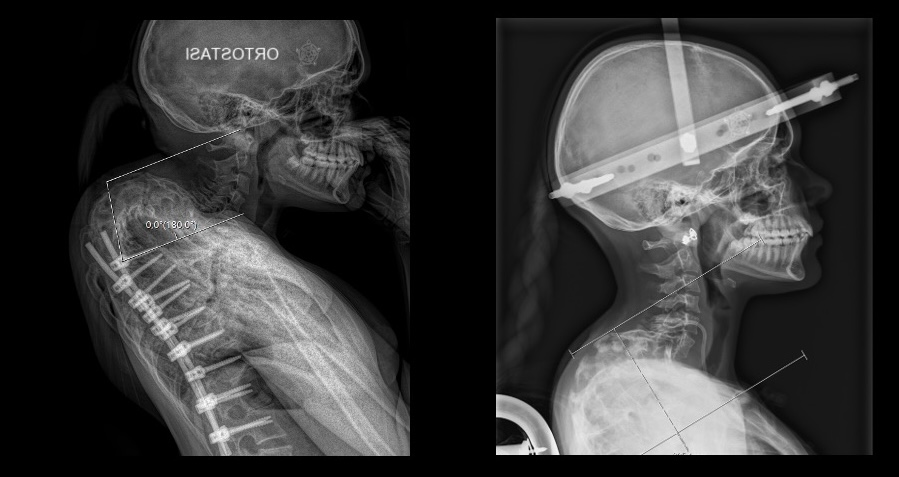
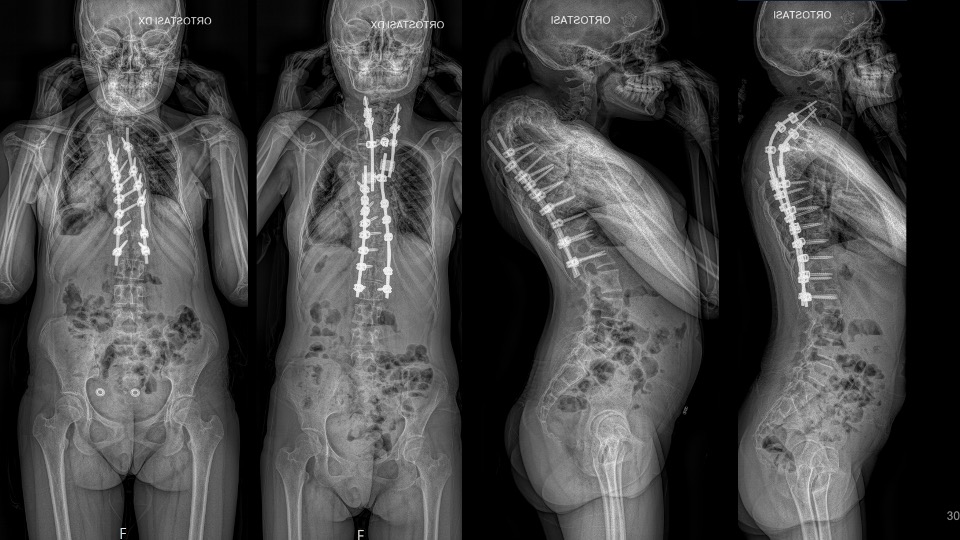
In Małgorzata's case, the deformity primarily involved the junction between the cervical and thoracic spine. Her spine had developed an extreme curvature, approaching 180 degrees. Her neck had effectively disappeared into the deformity, causing her head to sit dramatically lower than its normal position.
The situation was further complicated by the quality of her bone. In patients with neurofibromatosis, some vertebrae can be extremely thin, providing very limited and fragile anchoring points for the implants required to correct the deformity.
"Correcting a spinal deformity requires placing fixation points into the vertebrae and connecting them with rods to reshape and stabilize the spine. In patients like Małgorzata, however, the available bone is minimal, and every millimeter matters. A single misplaced screw can make correction impossible," the specialist explains.
Before definitive surgery, Małgorzata underwent an extensive preoperative preparation program involving Halo skeletal traction. This device, fixed to the skull and gradually connected to increasing weights, was used to slowly lengthen the spine and partially reduce the deformity.
This preparatory phase lasted nearly three months and proved essential both for making the surgical correction feasible and for allowing the spinal cord to gradually adapt to its future position.
"If the spinal cord is stretched suddenly during a major correction, it can suffer acute injury. Progressive traction allows us to reduce that risk by slowly preparing both the spinal cord and the surrounding tissues for the final correction," explains Professor Berjano.
Throughout this period, Małgorzata remained hospitalized together with her mother, facing not only the physical challenges of treatment but also an enormous emotional and psychological burden.
During these months, the International Department remained a constant and discreet presence. Its staff continued supporting both Małgorzata and her mother, facilitating communication with healthcare professionals, helping them navigate everyday life during hospitalization, and becoming a reassuring point of reference during an especially difficult period. Alongside the medical care itself, this human support helped make the journey more understandable, more manageable, and far less isolating.
The definitive surgery aimed to reduce the spinal curvature, stabilize the spine, and create the conditions for successful bone fusion.
To achieve this, the surgical team performed multiple osteotomies, carefully planned bone cuts around the spinal cord to increase spinal flexibility and allow correction of the deformity.
The procedure required an extraordinary level of precision and was made possible by the team's extensive experience combined with advanced surgical planning technologies.
Using a low-dose CT scan, specifically designed to minimize radiation exposure in patients who have already undergone numerous imaging studies, surgeons created a three-dimensional model of the patient's spine. This model enabled them to study the deformity in detail, precisely plan each surgical step, and produce custom 3D-printed surgical guides for implant placement, a technology developed with the contribution of Professor Claudio Lamatina and validated with the participation of Professor Pedro Berjano at IRCCS Ospedale Galeazzi-Sant'Ambrogio.
"In the most complex cases, technology does not replace surgical expertise, it enhances it by improving precision and reducing risk. Customized guides allow us to position implants accurately even in severely deformed vertebrae where very little bone is available," Dr. Berjano explains.
Equally essential was the contribution of the entire multidisciplinary team: spine surgeons, anesthesiologists, neurophysiologists, nurses, biomedical engineers, ward staff, and intensive care specialists. Like an orchestra, every professional had to know exactly what to do, particularly during the most delicate phases of the operation.
"Procedures of this complexity are never the work of a single individual. They require experienced surgeons, but also a highly trained, coordinated team accustomed to managing extremely challenging cases. What truly makes the difference is the ability to work together with precision and perfect timing," he adds.
Today, Małgorzata has reached a major milestone in her treatment journey. The correction achieved during surgery has significantly improved the alignment of her spine, restored a much more natural posture, made her neck visible again, and provided a far more favorable functional outlook.
However, her journey is not yet complete. In cases of this complexity, long-term follow-up is essential. Over the next two years, regular clinical and radiological evaluations will monitor implant stability, bone healing, and her overall recovery.
"At this stage we are extremely satisfied, we have achieved a major milestone. But with procedures this complex, caution remains essential. I will feel completely reassured only when, in about two years, we see a stable spine, solid bone fusion, and a patient who is doing well," says Professor Berjano.
If recovery continues as expected, Małgorzata can look forward to living a normal life: walking, going out, maintaining social relationships, carrying out everyday activities, and building her future with a level of freedom that once seemed impossible.
Beyond its technical and surgical aspects, this story is also one of remarkable resilience. For months, Małgorzata and her mother endured prolonged hospitalization, Halo traction, multiple procedures, uncertainty, and emotional strain while placing their trust in the medical team throughout an extraordinarily demanding journey.
"These patients often possess extraordinary resilience. They arrive after years of hardship, complex medical journeys, and sometimes great disappointment, yet they still find the courage to trust us. As physicians, we feel an immense responsibility, not only from a technical standpoint but also on a human level. We are not simply correcting a deformity; we are accompanying a patient and their family through a decision that has the potential to change their lives," concludes Prof. Berjano.
Throughout Małgorzata's journey, this sense of responsibility extended beyond the clinical team. It also involved the professionals who transformed the complexity of international treatment into a structured, coordinated, and sustainable pathway for both the patient and her family. This is precisely the mission of Gruppo San Donato's International Department: combining organizational expertise, deep knowledge of international care pathways, attentive listening, professional empathy, and continuity of support.
It is this synergy between clinical excellence, careful coordination, and patient-centered care that enables highly complex treatments to deliver life-changing results.
Małgorzata's case further reinforces the role of IRCCS Ospedale Galeazzi-Sant'Ambrogio as a leading referral center for complex spine surgery, bringing together specialist expertise, advanced technology, and truly comprehensive patient care, even in the most challenging cases.